Pulitzer Center Update June 17, 2026
With Pulitzer Center Reporting, 'Green Voice Matters' in Vietnam Offers Tips in Environmental Storytelling
Country:


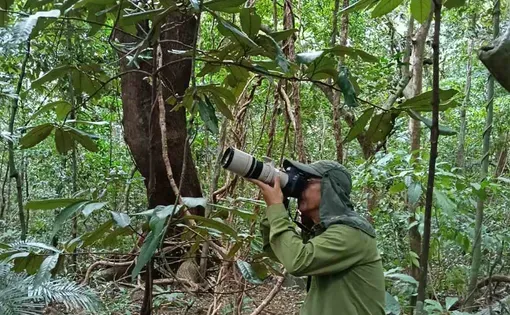
Officials have approved clearing 1.9 hectares of special-use forest.

From the acacia monocultures masquerading as forests to the plastic-choked coasts of the Mekong Delta, 48 students, lecturers, and Pulitzer Center Fellow and grantees in Vietnam spent two days learning how to tell the stories that matter, and why the right argument and data can lead to more impact.

Bringing engagement activities that highlight complex issues, such as deforestation, in the country is no easy feat. This is why our partnership with Van Lang University in Ho Chi Minh City, Vietnam, has been valuable.

Held on May 4-5, 2026, The Green Voice Matters (GVM) workshop at Van Lang University, draws on award-winning Pulitzer Center-supported journalism, including Vo Kieu Bao Uyen’s reporting on acacia tree plantations and Le Quynh’s project on the construction of a waste treatment plant in Con Dao. Inspired by the reporting, the two-day workshop encouraged students to explore the environmental, social, and economic dimensions of development and sustainability challenges in Vietnam.
Designed to foster curiosity and critical thinking, Green Voice Matters also equipped participants with writing skills that helped them engage more deeply with issues affecting their communities. By connecting journalism with education, the program aimed to strengthen students’ ability to express informed opinions on pressing topics, including deforestation, climate change, and their wider socioeconomic impacts, empowering students to become active and thoughtful contributors to public discourse.
Participants will compete in an op-ed writing competition, drawing inspiration from Pulitzer Center-supported stories to examine pressing environmental challenges and their impacts on local communities.
Bridging the gap
The numbers, when laid out plainly, are difficult to absorb.
By 2016, Vietnam had already lost 15,000 hectares of forest, far outpacing the 8,000-hectare loss projected for 2025. The gap between projection and reality was the first thing Pham Van The, a Van Lang University researcher, put on the table when he opened the Green Voice Matters workshop, and it set the tone for everything that followed: a day of reckoning with the distance between what official data says and what is actually happening on the ground.
Deforestation in Vietnam, Pham Van The explained, does not have a single face. Logging, permanent agriculture, and shifting cultivation each chip away at the country's tree cover in different ways and at different scales. Underneath these proximate causes sit harder-to-trace drivers: hard commodities, expanding settlements and infrastructure, and wildfires, the last of which often go unreported in national statistics.
For journalists in the room, the lesson was immediate and practical. The story of Vietnam's forests is not one story. It is many stories layered on top of each other, and telling any one of them requires knowing which layer you are in.
When a forest is not a forest

Bao Uyen arrived at the workshop with a question that sounds simple but cuts deep: What actually counts as a forest? In Vietnam's official statistics, acacia plantations do. In ecological terms, they do not.
Acacia trees are planted at industrial scale across Vietnam's hillsides, generating timber primarily for export to South Korea and Japan. On paper, they contribute to the country's forest cover. On the ground, they are monocultures, uniform, biologically thin, and managed entirely for commodity value. They support little biodiversity, provide limited watershed protection, and when harvested on steep slopes, leave the soil exposed in ways that accelerate erosion and, increasingly, trigger landslides.
The acacia story, Bao Uyen made clear, does not end at Vietnam's borders. Japan's post-nuclear energy transition has turned biomass into a significant fuel source, and Vietnamese wood chips are a key input. The demand is real and growing. But so are the costs: biomass processing releases burnt residues and wood chip dust that contribute to localized air pollution, a dimension of the "green energy" narrative that rarely makes it into the headlines.
"Do not blindly trust products or policies labeled as green," Bao Uyen said.
The warning applies as much to biomass as it does to the plantation forestry that feeds it.
The loophole that is often overlooked
Le Quynh has spent years writing about the gap between what environmental laws are supposed to do and what they actually enable. Her session began with her describing her work methodology.
Before she writes anything, she said, she talks to experts and engages government authorities directly, not to gather quotes, but to define the problem with precision. The journalism she is most wary of is journalism that arrives at a policy issue with a conclusion already formed.
What she has found through years of reporting, she said, is that policy exploitation often hides in plain sight, embedded in draft legislation as small trade-offs, written in language vague enough to give authorities significant discretionary power. As described in her reporting "Rapid Development, Legal Changes Put Pressure on Vietnam’s Forestland," the Environmental Protection Law, amended in 2024, offers a recent and striking example: It permits local governments to convert forests and to allow special-use forests, protected areas in principle, to be repurposed for tourism development.
"Most of my reporting and op-eds are not intended to directly solve problems," she told the room. "They aim to raise issues, spark public discussion, and increase awareness among readers."
The distinction matters. Reporting and op-eds that overpromise, that position itself as a solution, often ends up being neither good journalism nor effective advocacy. The more honest and, in Le Quynh's experience, the more durable approach is to clearly name what is happening, show where the evidence leads, and trust readers to draw their own conclusions.
180 tons, every day
Huynh Tan Loi, a professor in Van Lang University's Faculty of Environment, shifted the workshop's attention from forest to coast, and the numbers he brought were no less confronting. Along Vietnam's coastline, approximately 180 tons of waste are found every day. More than half of it is plastic.
Vietnam has a seawater desalination plant in the Mekong Delta, a marker of just how acute freshwater stress in the region has become. But the country's response to coastal degradation more broadly, Huynh Tan Loi argued, remains characterized by a lack of technological proactiveness: an absence of scalable, systemic solutions that match the scale of the problem.
The challenge is not only one of scale. It is also one of the data. For journalists trying to report on coastal ecosystems in Vietnam, and in much of Southeast Asia, the information environment is fragmented, politically sensitive, and culturally complex. In the Mekong Delta, for instance, collecting responses from women is particularly difficult due to entrenched norms around who speaks to outsiders, and who trusts them. Terrain itself is a barrier, cutting journalists off from the field conditions that data alone cannot convey.
Huynh Tan Loi reminded the room that data accounts for about 60 percent of research, but its reliability is entirely dependent on context. Satellite imagery, government datasets, academic journals, and field interviews all have their place. So do less obvious tools: Google Earth Pro, data scraping software, PDF-to-spreadsheet converters that can unlock information buried in official reports. And so do the stories that connect the local to the global.
Writing as if it matters

The afternoon turned toward the craft of writing. How do you take everything including the data, the policy, the complexity, the uncertainty, and turn it into something a general reader will actually read?
The workshop's writing guidelines were clear: Keep sentences short, avoid jargon, cut aggressively, lead with your argument. But underneath the craft sat something more fundamental. A good op-ed, the facilitators kept returning to, is not a summary of evidence. It is a claim, specific, contestable, and urgent, supported by evidence that has been chosen for its relevance, not its comprehensiveness.
Thesis. Evidence. What is at stake. In that order, and nothing that does not serve all three.
The participants left with drafts in various states of completeness, and with something harder to quantify: a clearer sense of the difference between knowing something and being able to argue for it in public. Vietnam's forests, its coasts, its policy frameworks, its data gaps, these are not abstract problems.
They are stories waiting for the right voice and the right argument. In an information landscape increasingly shaped by noise and speed, quality journalism remains one of the tools capable of turning complexity into public understanding. The Green Voice Matters workshop exists to help find both.
The Green Voice Matters program brings together Pulitzer Center Fellows and grantees, academics, and specialists to equip students with environmental and journalism literacy. Through expert storytelling, writing workshops, and mentored editorial exercises, participants will produce op-ed articles that amplify underreported environmental issues.
Huynh Tan Loi, of Van Lang University's Faculty of Environment, helped make this initiative possible.