Story
 October 7, 2025
Seeds Are Key to Restoring the Amazon Rainforest—and AI Can Speed Up the Process
Country:


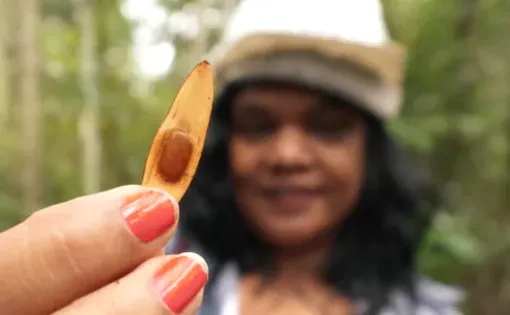
This reporting project will explore how AI aids seed viability for forest restoration in Tapajós...
A pioneering initiative uses Artificial Intelligence to predict the viability of native species and strengthen forest restoration in times of degradation and fires.
On the eve of the global climate conference, COP30, the year 2025 also marks the halfway point of the Decade on Ecosystem Restoration. Established by the United Nations (UN) for the period between 2021 and 2030, the initiative aims to prevent, halt, and reverse the degradation of ecosystems on every continent and in every ocean. However, it was not expected that these first five years of the campaign would be so critical in biomes such as the Amazon. The reduction in enforcement and actions to combat illegal deforestation at the beginning of the decade, combined with the severe effects of El Niño and extreme droughts in 2023 and 2024, made the restoration task even more challenging.
"We have no time to lose; we need to restore as quickly and assertively as possible. That's why we have to use technology to our advantage," emphasizes Lydiane Bastos, a forest engineer and researcher at the National Institute for Amazonian Research (INPA), based in Manaus. In September last year alone, forest degradation in the Amazon reached more than 20,000 km², which is equivalent to more than 13 times the size of São Paulo city. This was the largest area affected by environmental damage in the last 15 years. The data comes from the Imazon research institute, which uses satellite images to monitor deforestation and forest degradation in the Amazon.
With a vast area to be restored in different biomes in Brazil, priorities must be set. Mapping must consider the particularities of each ecosystem, planting species that are suitable for each environment. In addition, the increase in forest fires requires more agile and accurate public policies. "We plant one year, and the next year everything is lost. A forest that used to be humid has now become dry because of so many fires happening at the same time," explains Lydiane.

As a nonprofit journalism organization, we depend on your support to fund journalism covering underreported issues around the world. Donate any amount today to become a Pulitzer Center Champion and receive exclusive benefits!
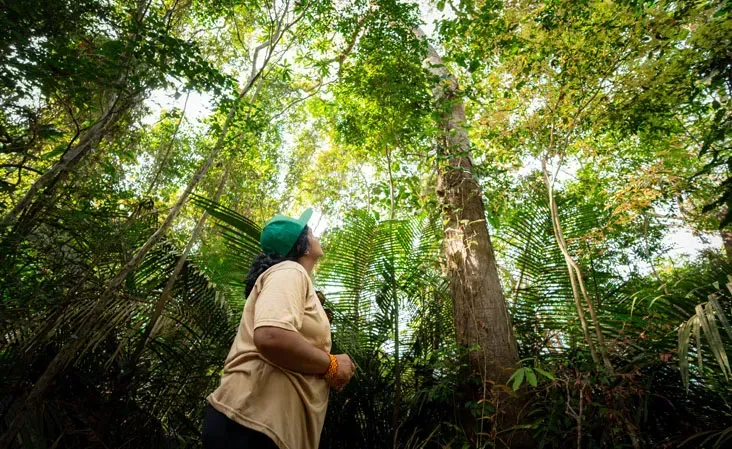
In an attempt to overcome these obstacles, science is using different approaches. Lydiane's research uses artificial intelligence to identify the most viable seeds of native Amazonian forest species. Funded by the Serapilheira Institute and the Amazon Foundation for Research Support (Fapespa), her project is collecting and capturing images of seeds from 200 forest species distributed across diverse ecosystems in the Lower Tapajós region of Pará: floodplains, terra firme, igapó, and campinarana—a type of vegetation that grows on extremely infertile sandy soils but is essential for the recovery of riparian forests.
After collecting the images using X-ray and scanner equipment, the research correlates them with germination tests carried out at the Forest Seed Laboratory of the Federal University of Western Pará (UFOPA), the only one in the North region certified by the Ministry of Agriculture and Livestock (MAPA). According to Lydiane, these analysis protocols allow for a quality report to enable seed trade. However, the process takes so long that it often becomes unfeasible for this chain. “Depending on the species, seeds can take weeks, months, or even years to germinate. So, by the time we find out whether that batch was viable or not, it is already impossible to trade,” she points out.
In addition, the technology makes it possible to identify which varieties of the same species, such as peach palm, are best suited to different environments, assisting in the planting and collection of seeds from healthier and more productive populations. The resource also supports species identification, a function previously restricted to DNA analysis, which works like a puzzle: the genetic material of plant cells is cut into pieces and each part is read in the laboratory. Then, with the help of a computer, these pieces are put together, revealing information about how the plant grows and adapts.
Based on the shape, weight, size, texture, color, and other visible characteristics in the images, it is possible to differentiate between similar plants, such as copaíferas, a genus of tropical trees that are often confused in the field because they have very similar leaves, bark, and trunks, with differences only in a few details. This information is organized and synthesized by artificial intelligence algorithms in seconds, ensuring accuracy and speed in the process, serving as a strategic tool for both collectors and forest restoration programs. “This is the magical world of artificial intelligence that we can bring to forest species, to differentiate, optimize resources, and collection and planting actions,” says the researcher, excitedly.
"I often say that seeds are the green gold of the Amazon. So, we can use them for everything: to produce oil, seedlings, bio-jewelry, fertilizer..."
—Lydiane Bastos, INPA
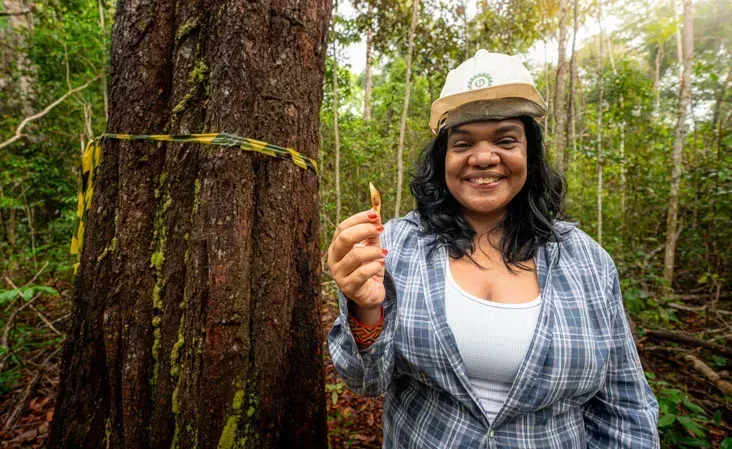
"Hope is stored inside seeds"
The first step in Lydiane's research begins in the field, with the help of seed collectors from each mapped ecosystem, who guide the researcher through the forest. Jéssica Reis, also a forest engineer, helps coordinate with the communities. She is the coordinator of activities at the Brazilian Agricultural Research Corporation (Embrapa) research forest reference center in Belterra and works side by side with Lydiane in the collection process.
Considering Pará's goal of restoring 5.6 million hectares by the end of the Decade onRestoration (2030), Jéssica points out that involving technology in this type of project makes the path easier. Or rather, less complicated. "For those of us who work with restoration and reforestation, it is a source of hope to see our forests being restored and replanted. And that hope is stored inside the seeds," she says.
She recalls the worst moments of the historic drought of 2023 and 2024, with fires and dense smoke, which affected reproductive cycles and delayed the fruiting of species such as andiroba, signaling the impacts of climate change. “It was like a scene from a horror movie! There was so much smoke, you couldn't see the horizon,” she says.
Given this outlook and with much work ahead, Jessica points out that AI can help select good parent trees (trees that provide material for propagation), making replanting more efficient and economical.
Challenges - Data from Mapbiomas, a system that gathers information in near real time on the impacts on Brazilian biomes, including the Amazon, reinforce how intense vegetation suppression has been over the last ten years in the regions of Santarém and Belterra municipalities, where the researchers' project is being developed together with the communities. A total of 236,000 hectares were burned and 89,000 hectares were deforested:
Researcher already envisions new technologies to improve fieldwork
Anyone who collects seeds in the Tapajós National Forest (Flona) needs to know the terrain well. In the dense forest, with no clear trail to guide them, they climb up and down, stepping on branches, dodging insects and venomous animals, and guiding themselves only by sounds and trees. It requires physical effort and ancestral knowledge not only to find the seeds they are looking for, but also to carry the heavy bags with the field collection out of the forest. Now, imagine if, after all that, those seeds are not ideal for planting? After all, they may be hollow or have fungi, which would invalidate all the effort. It is this type of situation that the project and technology seek to avoid. “It will reduce the distances and working time of the collector. We will be able to find out which matrices produce the most viable seeds, so that we can go straight to them,” adds Lydiane.
Under the tree canopy, Lydiane takes a deep breath as she prepares to put her hand in the soil and collect more seeds. Thoughtful, she already envisions the future: "I'm a megalomaniac. I have several ideas for this project. I'm going to spend my whole life doing this. I want to create an app so that collectors can take a photo of the seed on their cell phone and immediately know its germination rate," she plans.
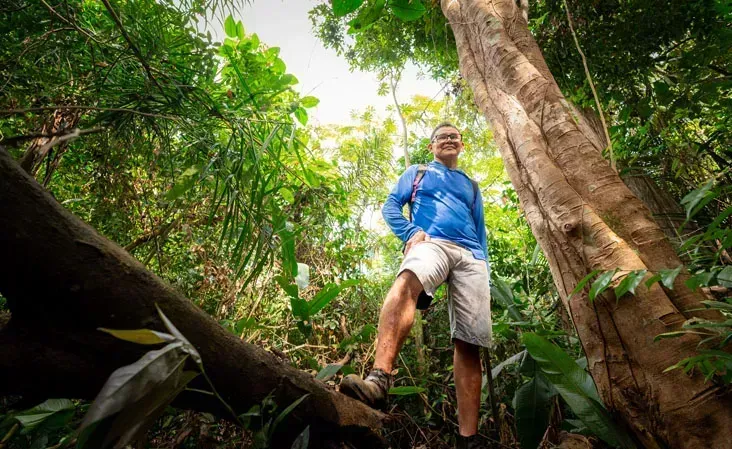
For José Viana, improving the quality of collection work is an incentive for the population to remain in the territory. The people of Pará have been undergoing a migratory process in search of work, especially to the Santa Catarina state, where they are already the fourth largest group of migrants.
“I have no envy, nor any desire to go live in the city. Here I feel free,” says José, with a smile on his face. Born and raised in the Tapajós National Forest, he doesn't need GPS to find his way around, nor does he need to take breaks to catch his breath on the long trails that tire those who are not used to them in minutes. "The forest is my second home. I have no worries or doubts about making mistakes, it's already engraved in my mind," he says.
His father was a rubber tapper and he started out in that business, but around the age of 20 he took the opportunity to work in botany, doing forest inventories for companies. Today, he focuses on collecting seeds, delivering them to his wife and daughter to help produce seedlings, which are sold for R$ 5.00 to companies that do forest restoration in the area.
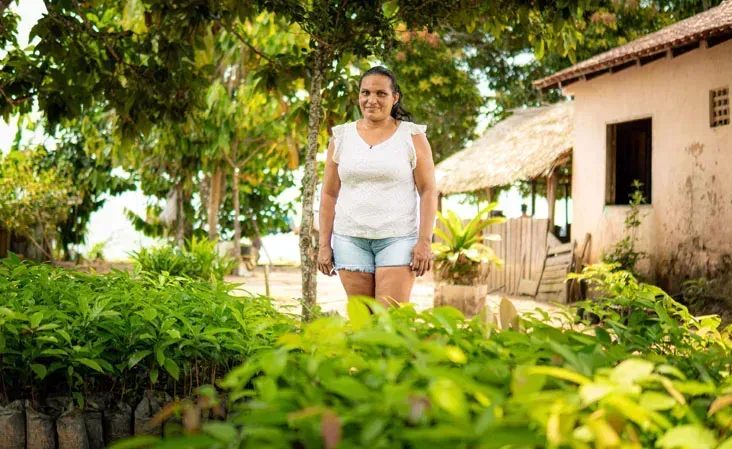
Her neighbor, Josiane Cativo, divides her day between activities at home, on the farm, and in the forest. The seeds collected in the national forest are sold both fresh and used to produce seedlings of various species, which are also sold to companies. “We still can't make a living from seeds alone, but if it were possible to earn money, I would much rather be working with seedlings, it's a pleasure for me,” she says.
"The forest is my second home."
—José Viana, seed collector at Tapajós National Forest
Pioneering analysis in the North of Brazil brings institutions together
To advance her research, Lydiane relies on a network of partners at different research institutions in the Amazon, combining technologies and knowledge to join forces. Part of the analysis begins right there, close to the collection areas, at the UFOPA (Federal University of Western Pará) laboratory in the municipality of Santarém. There, following protocols from the Ministry of Agriculture, the seeds are stored, evaluated, and provided with the ideal conditions for germination.
According to Professor Everton Almeida, coordinator of the space that emerged in the late 1970s, it took more than ten years to prepare the laboratory, train people, and establish this quality standard. “After accreditation, several other institutions also approached us to learn from this process. We are trying to increasingly coordinate with other initiatives and researchers to help as much as we can with the forest restoration chain,” he explains.
The seeds travel to one of the partner institutions where Lydiane also works: the Amazonas Native Seed Center (CSNAM) in Manaus, which has the only X-ray machine in the North region suitable for this type of work, as well as a high-resolution image scanner. This makes possible to identify any damage or malformation inside the seeds without having to open them. Once again, cutting-edge technology is nature's ally.
In Belém, at the Emílio Goeldi Museum of Pará, the second high-resolution scanner in the Legal Amazon is installed. Therefore, the exchange of knowledge and experience between the two institutions is essential. "Lydiane also works in the same field, we have the same equipment, and we met last year and noticed that we have the same work characteristics. That's why we decided to exchange experiences and knowledge within the whole context of native Amazonian seed technology," explains Olivia Ribeiro, a researcher at the Goeldi Museum, who uses artificial intelligence to characterize native Amazonian forest species, i.e., a detailed description of their physical, morphological, and functional characteristics.
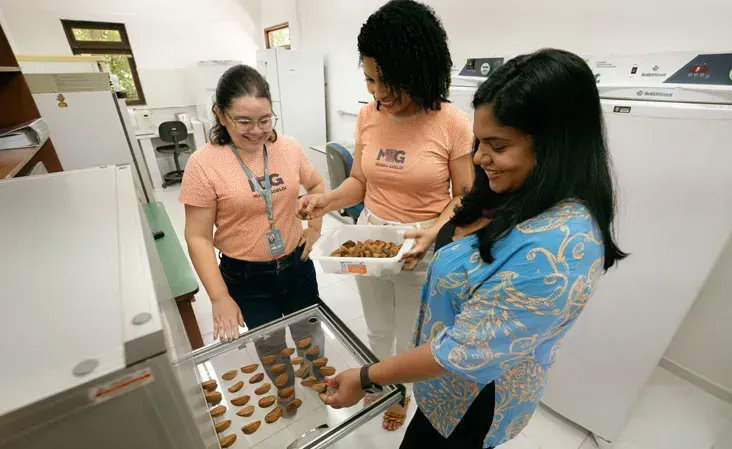
Appropriating technologies that agribusiness has been using for 60 years
Lydiane explains that the proposal is to bring forestry science and the cultivation of native species into the technological age, bringing the study of seeds closer to the current reality. "This is research that has existed in agronomy for many years. Since the 1960s, X-rays have been used for soybeans, for example. And forests have always been seen as secondary in the application of this technology and knowledge," she points out.
UFOPA professor Túlio Silva, a member of Lydiane's AI project, explained that the technology used can be used to go beyond seed viability, as it can provide answers about the effects of pesticides on forest species.
For example, given a scenario in which the area corresponding to the municipalities of Santarém and Belterra lost 56,000 hectares of forest between 2014 and 2024, which were turned into pasture, it is noticeable when traveling through the region how the protected forest is surrounded by soybean or cattle farms in various places.
The team is investigating how pesticide application in these neighboring areas may affect the nearby native forest in terms of germination and early development of forest species, which are more vulnerable than mature plants. "The Santarém region is an agricultural frontier where farming is growing rapidly. When a space is cleared for farming, in most cases, it is surrounded by forest. So, could this pesticide also harm the initial growth of a plant in a nearby area?" she asks.
This is one of the ways Lydiane's research could expand. In addition to predicting seed viability, artificial intelligence can help reveal the impacts of human activities, such as pesticide use, on the initial growth of forest species. Soon, with more research like hers, more answers to scientific questions can be discovered, unraveling the mysteries of the Amazon and paving the way for forest restoration to become increasingly efficient and resilient.
This project is funded by the Pulitzer Center through the COP30 Special Call for Proposals: Rainforest, Ocean and Transparency
The data collection, analysis, and visualization were produced collaboratively between InfoAmazonia and Amazônia Vox, and is part of the InfoAmazonia Citizen Network, an initiative to create and distribute socio-environmental content in the Amazon.
Credits
Author: Alice Martins Morais
Editior: Daniel Nardin
Photos and video: Matheus Melo
Original illustrations: Dedeh Farias
Data analysis: Renata Hirota
Map: Carolina Passos
Web Design / Programmer: Weliton Vieira Júnior
UX/UI: Alice Damasceno
Social Media: Maycon Carvalho
Portuguese grammar review: Eliani Martins
Spanish and English grammar review: Natália Mercado
Administration: Mariana Nardin
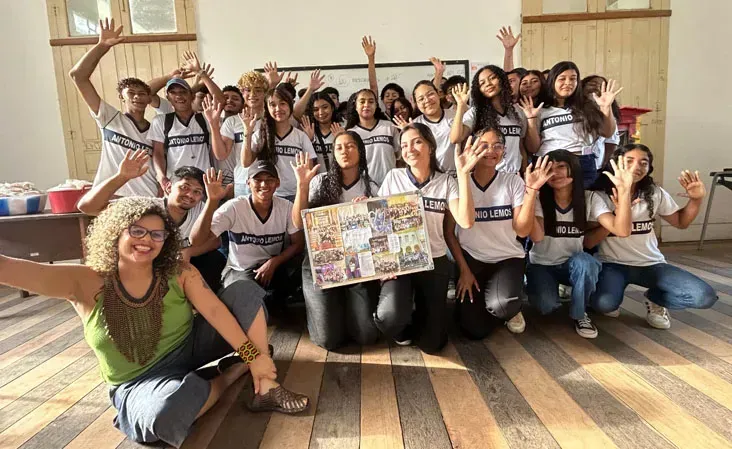
Text review by students from Antônio Lemos State School, in Santa Izabel do Pará, coordinated by teacher Marcela Castro.